Hypnic Headaches

7 Vitals of hypnic headaches

Sleep is a sacred bond between us and our beds.

When that bond gets broken, we suffer.

Learning what causes hypnic headaches can keep us from ending up with those 3 am head pain wake up calls.

In this article, I will be talking about what hypnic headaches are, what causes them, and what studies have found works really well for them.

What is a hypnic headache?

A hypnic headache is known as the “alarm clock headache” because it wakes you up at night with head pain. Even though it will usually wake you up at the same time each night, it commonly happens between 1-3am or 4-6am. It can be one-sided or on both sides of the head, is sometimes throbbing and lasts between a few minutes and 6 hours.

Watch this video to learn more about hypnic headaches.

7 Vital hypnic headache causes

Before we begin, we need to understand the clock that our cells live by.

This clock is similar to the clock that we use, but different in that it synchronizes itself based on the amount of light our skin and eyes are perceiving.

It is called our circadian rhythm and functions off of 2 main sources of light.

The bluish hue of the morning light that stimulates our body’s stress hormone cortisol to wake us up…

And the orangish hue of evening light that stimulates our body to drop the stress hormone cortisol and raise melatonin, our sleep hormone.

So cortisol wakes us up out of sleep and gives us energy and focus.

Melatonin is the opposite in that it makes our body wind down, prepare to rest, digest and repair our brains and bodies.

Here is an image showing our circadian clock and how it functions in a normal healthy person.
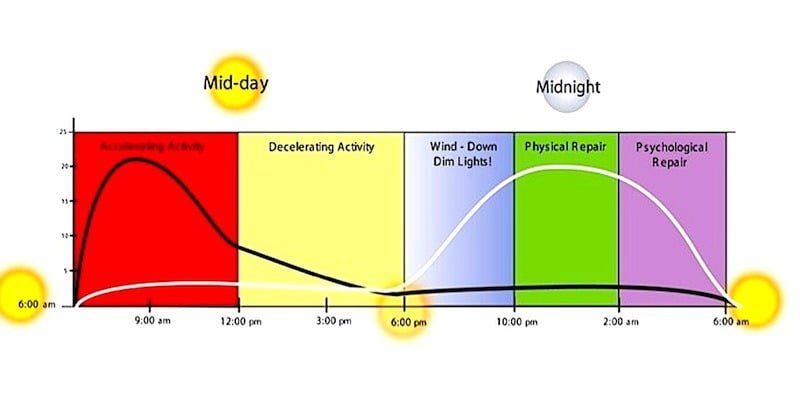
The black line is cortisol and the white line is melatonin. In the morning, cortisol spikes with the sunrise, and in the evening it drops with the sunset allowing melatonin to spike.

But our stress hormone cortisol may also go up any time we stimulate our body or mind.

  • If we work out, cortisol goes up.
  • If we go through a traumatic event, cortisol goes way up.
  • If we have caffeine, cortisol goes up.
  • If we are staring at sources of blue light like screens, cortisol goes up.
  • If we are stimulated by an action movie or another event that makes our heart pump, cortisol goes up.

But these aren’t bad, in fact, they are fairly normal. What matters is when this happens and how we respond to it.

It’s normal for cortisol to go up in the morning so we want to maximize our mornings for everything that requires lots of energy and stress.

This allows us to leave our relaxing and winding down activities for the evening, preventing us from raising cortisol.

It is easy to drop cortisol if we are consciously trying to do it(as long as it’s not artificially stimulated).

Only a few minutes of specific breathing can halve our cortisol levels after a stressful event.

See the video below to learn about how circadian rhythms work.

1. Optimize circadian rhythm sleep-wake

Our circadian rhythms are the most important cycle in our body because they regulate every single cell and bacteria we have.

There are a few keys to making sure they stay synchronized so that our hormones and cellular metabolism like our brain cells detox and repair properly.

They are:

  • Get direct sunlight every day for at least 15-20 minutes

  • Avoiding sleeping in late as once light is coming into your room, your melatonin drops

  • Sleep in blackout conditions with no light, street lights, lights from electronics and minimal stimuli like sounds and odors

  • Have room temperature be cool but not cold and warm your hands and feet before bed which has been shown to improve sleep cycle quality

2. Melatonin

Melatonin is our sleep hormone and has been shown in studies to help some hypnic headache sufferers.

But be careful with melatonin supplements…

1-3 mg taken sublingually(under the tongue) has been found to be effective whereas some supplements can have hundreds of mg of melatonin and this may cause drowsiness during the day.

3. Sleep foods

When we think of sleep, we have to understand that blood sugar and food quality plays a very large role.

Melatonin, our sleep hormone, is made from tryptophan which is an amino acid that comes from proteins.

The best food sources of tryptophan are:

  • Dark chocolate
  • Dates
  • Red meat
  • Fish
  • Poultry
  • Pumpkin seeds
  • Spirulina
  • Squash seeds
  • Lamb

For blood sugar, we need to know if we have blood sugar handling problems and most of us do.

Do you get irritable when you haven’t eaten for a few hours?

Do you get headaches if you miss a meal?

Do you get severe cravings or other symptoms if you miss a meal or don’t keep your blood sugar up?

These need to be handled through a nutritional protocol to rebuild your body’s ability to use food.

When blood sugar drops, we can actually go into a coma and die so our body regulates this very closely.

To compensate it uses cortisol because cortisol, as a stress hormone, puts sugar into our blood.

Throughout evolution whenever we entered fight or flight mode, our body would need lots of resources so that it could fight or run whatever was causing danger. It uses cortisol, our stress hormone to release sugar into our blood and make it available as fuel.

But this causes more problems if we suffer from head pain and have bad circadian rhythms because when blood sugar drops, cortisol goes up and this causes sleep quality to go down.

We want to avoid this.

Which means we need to balance blood sugar before bed by giving our body foods that support long-lasting energy.

Think of our metabolism as a fire. We want to put logs on it, not twigs, so that it lasts us throughout the night.

Good foods for this are:

  • Nuts and seeds

  • Wild fish

  • Dark leafy greens like spinach and collard greens

  • Vegetables with complex carbohydrates like yams, carrots and beets (not potatoes or grains)

  • Fatty pastured meats

See our article on blood sugar stabilizing foods here.
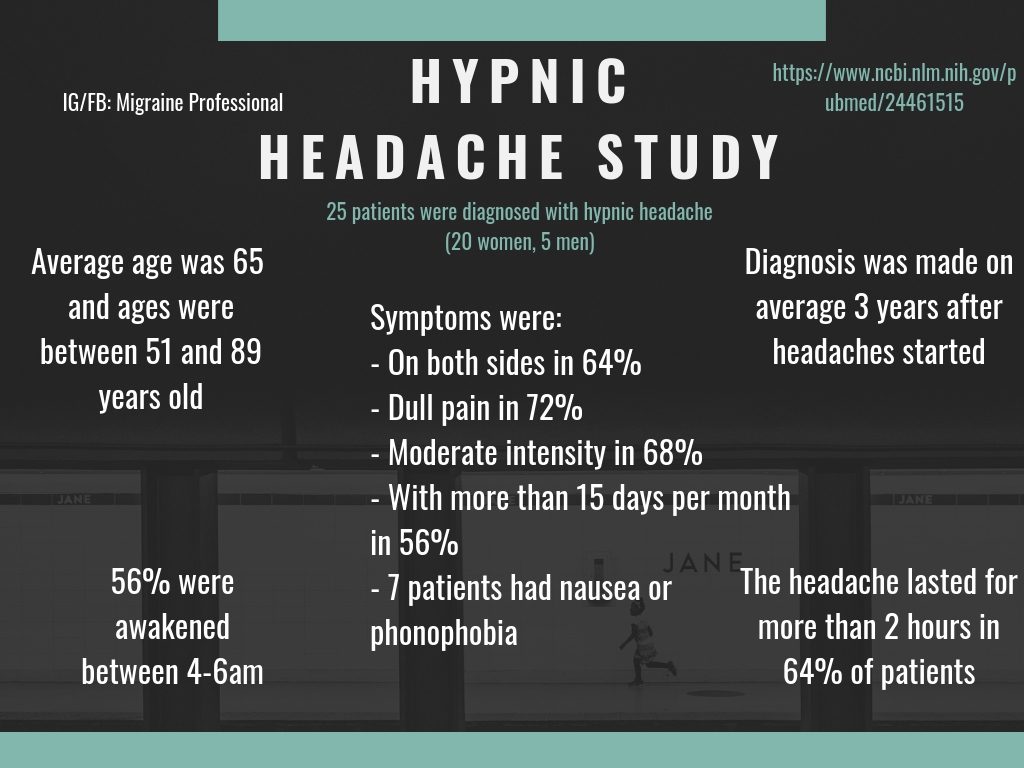
Hypnic Headaches Study

4. Kill blue light

Blue light is a 21st-century problem and has contributed to a massive amount of sleep dysfunction.

It is normal in the morning to have lots of natural blue light from the sun.

But in the evening and at night, blue light confuses the body into thinking it is still daytime.

This pushes back circadian cycles and keeps our body from being able to repair and detox when we fall asleep because it still has to raise sleep hormones and drop stress hormones enough to do it.

The best option here is to avoid all screens at least 2-3 hours before bed but it is unrealistic since we are culturally glued to our “smart” phones.

Instead, use these tips:

  • Get apps like twilight or night shift on your phone which drop the amount of blue light coming from your screen

  • Use apps like fl.ux on your laptop and desktop to prevent blue light from them

  • Use physical blue light filters on your screens

  • Sacrifice looks, for health, with these blue light blocking glasses

5. Liver, lung and large intestine

Do You Wake Up At The Same Time Every Night? Chinese Body Clock Explained!

When we want to understand what thousands of years of medicine can do for us we need to understand traditional Chinese medicine. This is one of the areas I use to interpret my client’s symptoms and it is very effective for dealing with root cause issues.

Our entire body goes by the circadian clock and our organs have specific times they go through their detoxification phases.

Between 1am and 7 am our body is going through liver, lung and large intestine detoxification and if these organs are having any trouble, we are going to get symptoms when it’s their time to clean themselves up.

This means we want to pinpoint which one is having issues and support them.

Do we feel congestion in the right side of our abdomen under our ribs?

Do we have loose stools, gas, diarrhea, constipation or unfinished feelings after bowel movements?

Do we have a cough, weak lungs, phlegm or live in an environment with poor air quality?

We want to take these systems into account and look deeper into them to understand if the issues they are having are overflowing into other systems like the brain, creating stress in the body and waking us up with pain.

What Your Body Clock is Trying to Tell You

6. Caffeine

According to this study,

“Caffeine taken as a cup of strong coffee seems to be the best acute and prophylactic treatment option.”

Caffeine can be amazing for hypnic headaches both before bed and on waking up with pain.

But this begs the question, is it because our body needs the boost in stress hormones? Is it because we are withdrawing from caffeine? Is it because our cycles are lopsided and need tuning?

Either way, coffee has been found to work well for hypnic headaches as acute and prophylactic solutions…

But this can be bad and cause more problems for those who are already exhausted.

If our body is so depleted in stress hormones that we have to squeeze even more out of it with caffeine, it is not a solution.

Remember, caffeine doesn’t give us more resources, it just attaches to our stress receptors and releases more of the resources we either do or do not have.

It is not a nutrient, just an empty stimulus.

But we can improve that with some tweaks.

Coffee is the most common way to get caffeine into your system so:

  • Use a high-quality organic coffee as coffee is highly sprayed with brain-damaging chemicals

  • Add some grass-fed butter, coconut oil or MCT oil to your cup to add a ton of nutrition and slow down the “burn”

  • Use a nutrient-filled sweetener like raw honey or real maple syrup instead of sugar

  • Add cinnamon or cacao for an extra boost

  • Avoid coffee after 2 pm if possible and not using it as a before bed prophylactic

  • Figure out if you are becoming dependant on caffeine

7. Sleep is brain detox time

In one study, 50% of hypnic headache patients had a previous history of migraine and 40% had underlying sleep abnormalities.

This means we need to figure out what caused our migraines because it could be causing our hypnic headaches and we need to fix our sleep abnormalities.

Migraines are often a protective mechanism used by the brain to make us stop what we are doing and increase the number of resources going to our brain to heal whatever is causing the damage to our brain cells.

See this article to learn more about complicated migraines, see this article to learn about what to do when a migraine or headache won’t go away and see this article to understand the migraine brain.

Sleep abnormalities are a huge issue and obviously connected to hypnic headaches so having a sleep study, fixing circadian rhythms, creating a wind-down routine before bed and reducing stress on the brain may all help.

When we sleep, our brain cells can shrink up to 20% so that they can rest, repair and “squeeze” out any waste products created during the day.

We want to make sure we support this process by taking the burden off our brain, lowering inflammation in our bodies, supporting our lymphatic system to remove waste and providing the nutrients our brain cells need to repair, grow and create stronger pain-free connections.

Click here to become part of the community where you will learn more about migraines and headaches than you ever have and what to do about them.

Share this post with others who need help with their sleep and let me know:

Have you ever experienced a hypnic headache?

See our video on hypnic headaches here:

Migraines, DHEA, Adrenal Fatigue and Exhaustion

Migraines, DHEA, Adrenal Fatigue and Exhaustion

How are Migraines, Adrenal Fatigue, DHEA and Exhaustion related?

Every day millions of people around the world suffer in silent, unnoticed pain with migraines.

At the same time, millions(if not billions) of people around the world are completely drained and in a deep stage of adrenal fatigue.

Here are some common symptoms of adrenal fatigue:

Could they be connected?

We already know that cortisol which is our main stress hormone does a great deal of work to give us energy and keep us focused as well as keep a healthy amount of sugar in our blood.

But when it gets overused… We get problems.

Inflammatory conditions like migraines, and conditions with the ending itis start to happen. (ex. arthritis, colitis, tendonitis)

Itis literally means inflammation.

When these conditions aren’t healed, when our body continues to get stressed and can’t turn off our stress mechanism so it can heal, tissue begins to harden.

This is when itis becomes osis and serious problems can come about.

So how can we connect migraines and adrenal fatigue?

Both are highly complex issues and can be caused by a number of sources.

But… They are both very connected to inflammation and hormones.

Just like Migraines, when we burn the wick at both ends, when we take too much out of our body and forget to put just as much back in, we run into exhaustion.

First, we burn our resources and our body will turn on because it thinks we are in danger.

This is when hormones like DHEA get burned to produce all the stress hormones we need like cortisol.

This is Stage 1 Adrenal Fatigue and we can feel really good, alert, aroused, even high in this stage.

Migraines aren’t very likely to be triggered here as you are still resilient and your body has resources available.

It’s always go go go when you’re Stage 1.

What you can do about it:

– Get tested by your doctor

– Slow it down (“Nature does not rush, yet everything is accomplished”) (Click here for a guide on avoiding the burnout that often leads to weekend headaches)

– Eat plenty of high-quality organic fats and proteins to feed the production of hormones(See this article for easy foods)

– Eat plenty of organic low sugar vegetables to cool the inflammation

– Use more energy building exercises to counterbalance the burn

– Find your triggers and eliminate them immediately

– Follow the foundation principles

Then Stage 2 comes and we still feel great, but our hormones start coming down because just like a car, they can’t maintain full throttle forever.

In this stage, things like a need for coffee and stimulants will come and we get cravings for foods full of sugar.

This is where our triggers start showing up, we start getting a high threshold and lots of tension in our bodies just waiting for something to break us into a migraine.

What you can do about it:

– This is when you need to re-evaluate if destroying your body is worth the stress

-You can use different superfoods known as adaptogens to help balance the body’s stress response

– See your functional medicine practitioner as it may be a good idea to supplement with DHEA which is well known to help migraines as well

– Pick up a practice of meditation and breathing to drop cortisol levels and ease your fiery brain

If we continue burning ourselves up Stage 3 comes along.

Stage 3 is when our body stops creating things that aren’t absolutely necessary like sex hormones.

Instead, it will use the resources for stress hormones and we will start getting a lack of energy, cloudy headed, suppressed immune system and just poor enthusiasm for life.

This is when everything starts falling apart, hormonal migraines are huge, migraines will completely drain you and triggers are just growing.

What you can do about it:

– In this stage, it’s very important to go into what is called a ‘fall’ or ‘winter’ phase of life and bring in a whole host of recuperative and healing foods, exercises, supplements, behaviors and deep healing

– Look for support as making changes yourself can be very hard and seem impossible

– These can be complicated migraines

Then it hits us, Stage 4.

Stage 4 is regularly called the burnout phase and rightly so, we feel completely burnt out and we are.

This is when our body can no longer take the abuse and neglect we put it through and its systems are shot.

Sex hormones and stress hormones are low and even neurotransmitters can be fried.

This leads to many symptoms such as depression, anxiety, lack of a sex drive, irritability, apathy, and fear.

In this stage, it seems like everything is triggering us and we simply don’t have the energy to do anything about it.

Migraines are running rampant and we can’t deal with them anymore.

Quality of life is severely diminished.

What you can do about it:

This stage requires help and it’s so incredibly important to reach out to your doctor, functional medicine practitioner or holistic health professional like myself and get support.

– DHEA deficiency is very likely and should be tested and supplemented for

– Follow the foundation principles

Remember that our body will produce stress hormones before sex hormones because it wants to be able to survive before it wants to be able to procreate.

But they both come from the same place, amino acids(which come from proteins) and fat/cholesterol.

It is much easier and much more bioavailable for you to eat high quality organic pastured fatty meats and get the hormones and support from them than it is through plants.

BUT if you eat low quality meats you will be creating the same problems you’re trying to fix so it would be better to eat vegetables.

See our video on adrenal fatigue, exhaustion migraines and tension headaches below:

Always check with your doctor before making any changes to your health or diet.

Do you find a connection between your energy and your migraines?

Try our 10 step system to build the body back up and help it recover from things like stress, injury, burnout and fatigue here.

Share and comment below to let me know if you’ve experienced that burnt out feeling with migraines.

Phantom Smells and Headaches

Understanding Phantom Smells and Headaches

Migraine auras are fairly common and said to happen in 20-30% of the migraine suffering population.

But auras and prodromes with phantom smells account for less than 1% of the migraine suffering population. (Study)

Some of the smells can be pleasant, and some can be painful to have to endure.

In this article, I’m going to be covering what phantom smells with headaches are and where they come from.

What are phantom smells?

Phantom smells, called phantosmia are a hallucination inside your olfactory or smelling system.

When the brain is affected by something like cortical spreading depression then wires can get crossed and signals can be sent through the part of the brain that processes smells.

Phantom Smells and Headaches width=

This can results in the sensation as if we are inhaling an odor. But it does not actually exist, hence being called phantom.

These can also be created by brain tumors, epilepsy, temporal lobe seizures or head trauma so it is important to see a doctor if you experience phantom smells.

In migraine sufferers, phantom smells usually comes as part of the migraine aura or prodrome.

When the brain has been sufficiently damaged by stress then it will go through a cascade of responses creating cortical spreading depression and triggering migraine.

What is cortical spreading depression?

Cortical spreading depression has become the biggest buzz around migraines with aura in recent years.

It actually gives us a way to understand what is happening during a migraine aura and why.

I’ll keep it simple to make it understandable as the brain can get quite complex and there is a lot about cortical spreading depression we still don’t know.

Cortical spreading depression is a wave of electrical activity that goes throughout different parts of the brain depending on what is affected.

This wave is a series of “blackouts” where the electrical activity drops and “restarts.”

This event may be very damaging to the brain and is present in conditions like migraine and epilepsy.

To tie it to a metaphor, its like you are running your house on a gas generator.

But this gas generator is running out of fuel so the electricity coming out of it is uneven.

This causes the lights in your house to flicker on and off.

The fuel is running low and we need to fix it.

The brain protects you from this energy shortage by ramping up its protective mechanism we call migraine.

It uses the migraine to increase the delivery of nutrients and amplify its ability to repair damage and improve energy generation throughout the brain.

Just like all of our other pain reflexes, they are there to signal to us there is danger, make us stop doing what we are doing, and focus on what is going on.

To understand more about migraine auras see our article on the 3 truths of frequent ocular migraines with images here.

To learn more information than you’ve ever known about migraines, headaches and what to do about them, join the migraine professional community here.

status migrainosus intractable migraine is Definition Treatments 72 hours

Understanding Status Migrainosus with Intractable Migraine – Treatments, Symptoms & Causes

Status migrainosus has been associated with an almost 2 times risk for suicide above regular migraines. (Study)

Having a regular migraine by itself is enough of a pain, let alone when it lasts over 3 days and doesn’t respond to any medications.

Throughout the years I’ve successfully helped clients heal their migraines and headaches and in this article, I will be talking about 3 life-saving ways to understand what status migrainosus with intractable migraine is and what you can do about it.

Let’s start at the beginning.

What is a status migrainosus with intractable migraine? / Definition

Status migrainosus is described by the International Headache Society as a:

“Debilitating migraine attack lasting more than 72 hours.”

An intractable migraine is often described as being the same as status migrainosus but has a different meaning.

An intractable migraine is one that is:

Difficult to treat and does not to respond to standard and or aggressive treatment”

So status migrainosus with intractable migraine is:

A debilitating migraine attack lasting more than 72 hours that is difficult to treat and does not respond to treatment.

With / without aura

When an intractable status migraine comes with symptoms like visual blurring, zig-zagging, euphoria, depression, cravings etc. prior to the head pain phase, this is known as with aura.

When it comes without any prior warning in the aura or prodrome phase then this is without aura.

Symptoms of status migrainosus

Status migrainosus generally comes with the same symptoms as other types of migraine.

There are sometimes symptoms before the head pain in the prodrome or aura phase…

Followed by the attack phase that is known for its head pain…

And finishing off with the postdrome or more commonly known “hangover” phase.

Common symptoms of any of these phases include:

Migraine symptoms


Triggers and causes of status migrainosus and intractable migraines


Triggers of Status migrainosus can range from the simplest of things like lights, sounds or smells…

To really complicated issues that you need to have functional medicine testing for, like hormonal imbalances, gut dysbiosis, and toxicity.

It’s important to discover and understand both your triggers and causes.

Triggers are the actions, thoughts, feelings, and events that cause your trigger level to cross your threshold level and result in the trigger of a migraine.

Things like:

  • Foods(Inflammatory, sensitive or stimulating)

  • Food additives(MSG, sulfate, nitrate, histamine, tyramine, artificial sweeteners)

  • Beverages(High caffeine, high sugar, and alcoholic drinks)

  • Environmental changes(Weather, barometric pressure, temperature)

  • Sensory stimuli (Lights, noises, scents)

  • Medications (Rebound medication, stimulants, sedatives etc.)

  • Hormonal changes (Puberty, menses, menopause)

  • Physical activity (Overdoing, stretching, straining)

  • A stressful event

Causes are the series of stressors that put a load on your body and raise your trigger levels over time.

They can come from:

  • Mental Stress like work

  • Physical stress like over exercise or structural imbalances

  • Emotional stress like relationships or trauma

  • Nutritional deficiencies or excesses

  • Environmental stress like sick buildings, EMFs, poor quality air etc.

  • Lifestyle stress like a lack of movement, sunlight, poor breathing patterns etc.

  • Chemical stress

So causes are: all the factors that add to the trigger levels and triggers are: the pieces that just send our trigger levels over our threshold and cause our body to switch to the protective mechanism we call migraine.

It’s important to differentiate the two as some triggers will not show up until our causes have brought our trigger levels high enough to cause our body to react to and become sensitive to benign things like weather, scents, lights etc.

At which point the trigger sends us into a spiral and catches all the blame.

Most common treatments for status migrainosus with intractable migraine


This video will go into detail about what to do with a migraine that just won’t budge like intractable or status migraines.


Now let’s get into the good stuff.

How to understand status migrainosus

 Status Migrainosus Intractable Migraines

Before we get into the 3 lifesavers that studies have shown may reduce and even abort migraines, we need to understand what is going on and what we are trying to do.

So we understand trigger levels and our threshold along with triggers and causes.

And now we need to understand migraine.

The simplest and most beneficial way to understand migraine is as a protective mechanism created by the brain.

This study done by Dr. Borkum found that migraine is actually used as a way to increase the number of protective nutrients that are in the brain, so that the brain can stop the damage being done to it and help it repair from it.

This study actually talks about how we can use migraines to support neural regeneration which is the regeneration of our brain cells.

This is big and completely changes the way we look at migraines, for the better.

It means that migraines, like other types of chronic pain, are only a symptom of the damage that is going on.

This makes sense because, throughout evolution, our body has used pain as a reflex to protect us from danger like the heat of a fire.

What is causing the damage?

That is the million dollar question.

But there’s a problem with it because it is not that simple.

In the book, Heal Your Headaches, Dr. David Buccholz a neurologist and headache specialist actually says that migraines are a mechanism and that headaches may actually fall under the migraine mechanism.

Of course, a migraine and a headache are regarded as different but a cluster headache can be very similar to a migraine and cluster headaches have been known to turn into status migraines.

This is one of the reasons why diagnosis of all the different headache and migraine conditions can be so difficult…

In reality, as opposed to theory, all the symptoms blur together and there are no neat and clean lines.

The damage comes from a number of factors and these three life-saving ways will outline:

1. What some of the maintaining factors are to brain damage and pain triggers

2. How the brain is usually protecting itself from damage with nutrients and how migraine sufferers with nutrient deficiencies get more migraines

3. What nutrients to use and where to get them for brain health

3 Life-saving ways to understand what status migrainosus with intractable migraine is


Before we start it’s important to understand all of the above pieces.

See my video on status migrainosus and intractable migraines below.


But when we look at a source of pain that is not responding to treatment and lasts more than 72 hours, what are the first thoughts that come to your head?

Something is keeping the pain going

and

The body is not repairing quickly enough and doesn’t have what it needs to do so completely

And this is exactly what studies have found.

So let’s get into it and learn.

1. Maintaining Factors

Status migrainosus intractable migraines

First thing is first.

When there is a fire, stop throwing gasoline on it.

This takes some detective work and without proper functional medicine testing may take years to pinpoint but here are the main areas you need to look at.

Physical/Structural

  • Muscular and skeletal imbalances will continually pull on your body, shoulders, neck and head and can come from many, issues like posture, ergonomics, vertebrae out of place and seemingly unrelated issues like overloaded organs

Mental

  • We need to learn to tame the over thinking, overworking, over worrying monkey mind. It may have benefited us at some point and that is why we started using it but it is now a detriment to our health and we have to learn to calm the massive amount of strain it puts on our entire body from our breathing to our digestion to our hormones and adrenals.

My favourite ways to do so include:

  • Practising gratitude
  • Breathwork
  • Contemplation
  • Journalling

Emotional

  • Emotions only last a few minutes when something happens, but when we hold on to them and cannot let them go, they will stay inside of us, charged for years. If this charge doesn’t get released, it will grow, bubble and boil inside of us, wrecking our bodies ability to cope. We have to find ways to vent and express our emotions, however our body needs it.

Nutritional

  • Food aggravations are one of the main causes of migraines. If we continue eating a food our body doesn’t tolerate, causes inflammation or is getting through our leaky gut and leaky brain… We can actually end up with food particles in our brain that are being attacked by immune cells and causing severe brain damage. Queue the migraines. But that is just one piece.

  • Our gut-brain axis controlled through our vagus nerve will send any danger signals from our gut, into our brain and this makes for hair-trigger migraines.

  • This was such an important topic that I had to write a book about it which you can find here.

Environmental


Sick building syndrome is the epidemic of the 21st century and is a massive strain on our entire body and every system we have. From recycled air, to mold, to electromagnetic fog to fluorescent lighting to off-gassing of chemicals from construction, furniture and supplies and on and on… The environment you live, work and sleep is either supporting you or draining your resources. See our video on fluorescent light here.


Parasitic/Gut/Immune


Parasites are thought of as a third world problem but estimates are that around 90% of first world people have an active parasitic or fungal infection. These pests create lots of waste and by-products, many of which are neurotoxic like the ones from candida. They need to be screened for and the body needs to be supported enough to get rid of them. Itchy-foot, itchy scalp, itchy groin, they’re all likely infections.


Hormonal


The massive influx of poor dietary choices with empty carbohydrate and tans fast heavy foods, along with xeno-estrogens like BPA and heavy metals like those found in makeup products create huge hormonal imbalances. PMS is a relatively new problem and is connected to all of the rubbers and plastics we use in everyday life that are full of endocrine disruptors that send our hormones through loops. They need to be detoxified properly and the good hormones need to be fed right.


Lifestyle

I screen all my clients and help them find fixes for common issues like breathing imbalances that cause or are created by bad posture, leading to neck breathing and often chronic headaches nobody else can fix. There is a huge number of lifestyle factors that need to be taken into account like water quality, circadian rhythms, quality light, movement patterns, ergonomics, hygiene and more.

It’s recommend to:

  • Get a full set of tests from a functional medicine practitioner or naturopath

  • Get a physical assessment from a NUCCA chiropractor, CHEK practitioner or osteopath

  • Have therapy and trauma release therapy if mental or emotional stress is involved

  • Get a holistic lifestyle coach or taking our 10 steps program

When we have stopped aggravating, then we can start supporting the areas of our reparative systems that are deficient.

If you need help, feel free to reach out to me here

Nutritional Deficiency

status migrainosus intractable migraines

Migraines have been found to be relieved and avoided through a huge number of nutritional methods.

One of the most effective ways to abort a migraine attack with 90%+ efficacy is IV magnesium.

Magnesium is just a simple mineral but is actually recommended in this study to be used in all migraine patients because half of all migraine sufferers may have a magnesium deficiency.

This is true for many different nutrients, but the amazing thing is that nutrient supplementation is so incredibly safe. Far safer than many migraine medications and this makes it a great way to go about healing stubborn migraines.

If our body is receiving the nutrients it needs to repair damage and prevent it from happening, it will be far less likely to have to trigger a migraine and go into protection mode.

Again, testing here is important and making sure your diet excels will give you much more benefit than just supplementing can.

So what are the most commonly deficient nutrients in migraine sufferers that may play a part in how they develop?

Magnesium (Study)

Magnesium is an amazing mineral and is warranted in most migraine cases because of its increasing deficiency in foods as well as amazing safety.

Some of the best ways to get magnesium is through:

– Magnesium flake and epsom salt baths

– Topical magnesium chloride spray

– Magnesium threonate, oxide, citrate and glycinate supplementation

– Magnesium rich foods (Dark chocolate, nuts, seeds, leafy greens, avocado, fatty fish)

See our video on magnesium here.

Vitamin D (Study)

Vitamin D is incredibly important because of the large deficiency of it in our culture. It is actually not a vitamin and should be renamed because it is a steroid hormone and affects every cell in our bodies.

Some of the best ways to get vitamin D are through:

  • Vitamin D3 supplementation

  • Direct, timed sunlight onto the skin

  • Foods such as (Fatty fish, liver, high quality eggs, pastured pork and some sun bathed mushrooms)

Vitamins B2-B3-B6-B9-B12 (Study) (Study) (Study) (Study)

The B vitamins are water soluble and any excess that gets eaten in that moment is urinated out. This means we need to get it regularly through our food or supplementation to meet our body’s needs but luckily they are available in many foods.

The supplements are generally known as a B complex but individual doses of higher amounts such as with riboflavin(B2) may be necessary.

Some migraine sufferers have genetic methylation issues so the B vitamins that are supplemented with need to be methylated like methyl-hydroxycobalamin(B12) and methyl-folate(B9).

The best food sources of B vitamins are:

  • Liver and kidneys

  • Clams

  • Sardines

  • Beef

  • Trout

  • Salmon

  • Non pasteurized and pastured whole milk

  • Eggs

Oxygen (Study)

Oxygen is used as a therapy to relieve tension, cluster and migraine headaches.

But what if it’s actually a deficiency caused by our breathing patterns, posture, organ health etc?

If we have bad posture, we can easily reduce our breathing by 30%.

If we have an inverted breathing pattern, which is common in many women because of cultures desire to have a flat stomach causing armouring around the diaphragm…

Then this will reduce the oxygen intake, lymphatic pumping and increase tension on the entire shoulder, neck and head complex.

Using simple breathing techniques and fixing our breathing mechanics can create a massive release of held up emotion and tension. See this article for more.

If you need breathing exercises go here.

Coenzyme Q10 (Study)

CoQ10 is amazing for its ability to cut headaches by 55% after 3 months of supplementation.

It is a massive antioxidant and can help protect our brain from damage caused by the most basic form of stress, oxidation.

It’s in many organ foods that our culture no longer eats, instead, opting for the muscle meats that have far less nutritional value.

Carnitine (Study)

Carnitine is an amino acid used in some migraine studies and is a by product of our body breaking down proteins.

It’s incredibly safe and easy to get through foods like:

  • Grass fed/finished Beef

  • Pastured Pork

  • Wild Fish

  • Insect fed Chicken

Alpha lipoic acid

Alpha lipoic acid is an antioxidant and helps prevent damage that can happen in the brain. Many foods have ALA but in low amounts so supplementation may be more effective.

When we are choosing nutritional supplements we have to remember that in nature everything comes in a nutrient complex.

Every nutrient comes with hundreds of other nutrients, bound together which all support the absorption and utilization by our bodies.

Every vitamin comes with minerals, enzymes, proteins, fats, carbohydrates co-factors etc.

So we want to make sure our diet is optimal and then supplement over and above an already solid diet.

Of course, what is most important, because of the varying causes for migraines is that the person’s total picture is taken in, testing is done across a few different areas and their specific issues are found because, in the body, everything reacts and supports everything else.

This is the basis for integrative medicine and the reason why so many therapies like nutrition, exercise, circadian rhythm synchronization, meditation and lifestyle therapy work so well for migraines.

And then there is using the science of nutrition to heal disease.

Nutritional Intervention

Status Migrainosus Intractable Migraines

In this study, through changing the diet of 60 migraine patients, 85% became migraine free and 100% improved.

This is no small thing.

Diet is a huge factor in both aggravating the brain and body, but also in healing it.

And it may actually play one of the largest roles in migraines, right up there with emotional stress.

So what are the best ways to use nutritional intervention for the migraines that just won’t end?

The hard answer is that we have to find all of the foods that are aggravating our bodies. This is often many processed, packaged, sugar-laden, additive-filled and over consumed foods.

Our bodies require lots of variety and whole foods… It evolved with them.

But luckily, the same whole foods that can help us steer clear of the bad ones, can give us the nutrients to heal our gut, brain, and pain.

The fastest way to do this is by starting a full elimination diet, going down to 2 or 3 definitely safe foods and then slowly working our way up and reintroducing/testing new foods every 2-3 days, eliminating those that cause aggravations anywhere in our body and keeping those that support us.

But this isn’t always doable for many people as its extremely strict so I’ve provided the resources below.

Some diets that work well for migraines depending on the cause are keto-genic, elimination, histamine and oligo-antigenic.

Our body has many signs that a food was wrong like brain fog, low energy, cravings, wired and tired feelings, burping, bloating, gas, loose stools, bad breath, mood swings etc.

We need to listen and learn from what it says. This is why I created the food triggers guide, the migraineur food pyramid, the 10 steps program and wrote these articles on what to do when you eat a clean diet but still have migraines, top 10 blood sugar stabilizing snacks and can a diet solve migraines?

When we can:

  • Stop the fire from getting gasoline thrown on it

  • Give our body the nutrients it’s missing that are starting the fires and preventing healing

  • Use nutrition to intervene

We can find ourselves much more successful in our healing approach and avoid long-term pain.

I have prepared a special webinar presentation which covers the WHY and WHAT to do about this constant brain pain and inflammation entitled The 3 Linchpin Areas That Destroy Hormones And Leave Your Brain In Pain. In this webinar I cover everything from why this is happening to what you can do about it as well as why these issues are rarely resolved properly.

To see the free webinar presentation click here.

Have you ever experienced a status migrainosus? What was your experience like and what did you do for it? Comment below.

Share this with someone else who is experiencing a hard time with migraines.

SUNCT Headaches Syndrome

5 Incredible tools for SUNCT headaches syndrome

Some headache conditions are extremely rare and painful.

SUNCT is one of them.

This syndrome can attack up to 200 times per day with pain frequently reported as a 9 out of 10.

In this article, we will be talking about 5 Incredible tools for the SUNCT headaches syndrome.

Let’s start at the beginning.

What is SUNCT headache syndrome?

SUNCT stands for short-lasting unilateral neuralgiform headache attacks with conjunctival injection and tearing.

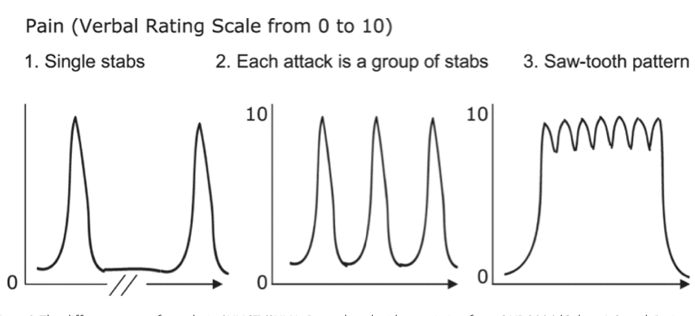
This is a type of moderate to severe pain in the head, around the eye or temples with single stabs, stab groups or a saw-tooth pattern. Below is a picture describing the pain type.

SUNCT Headaches Syndrome

With symptoms often only on one side, it is related to the trigeminal nerve and comes with eye redness and tearing on the affected side.

Pain comes on quickly, peaks, generally lasts between 5 seconds and 4 minutes and on average there are 5-6 attacks per hour.

It’s a type of trigeminal autonomic cephalalgia(TAC).

It most commonly occurs in men after age 50.

There is a lack of effective drugs as well as a lack of studies on new drugs, nutritional and lifestyle therapies that are being used on other headache disorders.

But we will make some connections and talk about tools you can start using today for pain and inflammation.

See this slideshow to understand more about SUNCT:

Symptoms of SUNCT headache syndrome

The most commonly reported symptoms are:

  • Pain in the head, temple or around the eye
  • Single stabs, groups of stabs or a sawtooth pattern of pain
  • Tearing
  • Eye redness
  • Drooping and swelling eyelid
  • Nasal blockage
  • Forehead sweating
  • Facial flushing
  • A sensation of fullness in the ear

To get a better understanding of SUNCT see the video below:

Triggers and causes of SUNCT headache syndrome

There are many different triggers for SUNCT headaches and some of them the same as cluster headaches and migraines like certain lights, scents, and smoke.

These are the most commonly reported triggers:

  • Touching the face or scalp
  • Washing
  • Chewing
  • Eating
  • Talking
  • Coughing
  • Blowing nose
  • Showering

Even though we want to avoid triggers as much as possible we need to look deeper at the cause or we will continue chasing pain in an endless loop without relief.

The causes are largely reported to be unknown because of a lack of agreement on any one area. This is the same for most chronic head pain disorders and especially for the TACs.

But there are some key areas we need to look at and they include:

  • CGRP
  • Glutamate
  • Inflammation
  • Parasympathetic / sympathetic nervous system dysfunction
  • Nerve dumping
  • Structural issues
  • Hypothalamus/brainstem/trigeminocervical complex activation

We need to understand that pain is a protective mechanism by the body used to bring awareness to us. It’s used to signal danger and to force us to stop doing what we are doing that may be causing the pain.

The causes of pain are many and can come from any area of life which means we need to look at our body holistically and see a health practitioner that uses mind/body medicine.

Assessing our mind and body to find where dysfunction is coming from is a much healthier, more rounded and effective long-term care plan and doing this will give us a multidisciplinary approach we can use to find relief.

Surgery / Treatment of SUNCT headache syndrome

 SUNCT Headaches Syndrome

The classic treatments that have been found to be effective for SUNCT include:

  • Lidocaine
  • Prednisone
  • Topiramate
  • Gabapentin
  • Lamotrigine
  • Occipital nerve stimulation (Link)

But these are not always effective and don’t provide a long-term drug-free self-sustainable model of health.

We don’t want to just numb pain and reroute it to a different area, we want to address it, learn from it and heal it so that we can get back to our normal lives.

This means we need to look at all the different areas of our life that issues can be coming from including:

  • Mental patterns
  • Emotional patterns and trauma
  • Lifestyle disorders
  • Upper cervical and other structural imbalances
  • Nutrition and nutritional deficiencies
  • Parasitic infections
  • Hormonal imbalances

If we can address the root cause of what is causing dysfunction in our lives, we can often find relief from the chronic pain that plagues us.

5 Incredible tools for SUNCT headaches syndrome

1. Triggers and threshold

Before you start on the healing journey of any chronic head pain disorder it’s important to understand your trigger level and threshold level.

Trigger level is the sum total of all the stressors on your body right now.

It’s the combination of everything that adds to your body’s burden including:

  • Mental stress
  • Emotional stress
  • Physical stress
  • Environmental stress
  • Social stress
  • Cultural stress
  • Dietary stress
  • Spiritual stress
  • Electromagnetic stress
  • Chemical stress etc.

The threshold level is the level of tolerance your body has to its total stress burden.

If your trigger level crosses your threshold level, your body is no longer able to maintain normal functioning and goes into what is commonly called a flare state.

In this flare state, the body is highly aggravated and the weak area in our body succumbs. If we have chronic head pain like SUNCT then this pain will be triggered.

We want to keep our trigger levels down by reducing the total stress coming in from all areas of our life. And we want to keep our threshold level high by supporting our bodies, healing, repairing and detoxifying systems while also providing positive stress that helps build resilience like exercise and cold showers.

2. Foundation principles

The foundation principles are the main and most important systems in our bodies functioning that support health.

If we have our foundation principles working well, then they are constantly draining our trigger levels because they help our body release stress.

The foundation principles are:

  1. Thinking
  2. Drinking
  3. Breathing
  4. Eating
  5. Moving
  6. Sleeping

Thinking – Understanding when we are caught in stressful thought patterns and how to bring ourselves out of them and release tension.

Drinking – Drinking plenty of high quality water(not tap) with bioavailable minerals away from meals to support detoxification and water exchange inside each of our cells.

Breathing – Retraining our breath so that we breathe long and deep as well as noticing when stress is creeping up on our lives and causing our breathing to lock up.

Eating – Eating whole foods in proportions that are ideal for our bodies stress needs and avoiding sensitive and trigger foods that add to inflammation and immune burden.

Moving – Quality movement that helps free up our spine and detoxify our lymphatic system through pumping and opening up tight areas.

Sleeping – Getting adequate quality sleep every night so that we can synchronize our circadian rhythms and so that our brain can go through its most important detoxification phase while we sleep.

Each of these are very deep topics that the majority of chronic pain sufferers are not taking full advantage of in their healing protocol.

To get a deeper understanding of the foundation principles click here.

3. Upper cervical health and nerve dumping

SUNCT is one of the trigeminal autonomic cephalalgias and this means that it’s connected to the trigeminal nerve and related to the functioning of our autonomic(think automatic) nervous system.

This means we need to understand that any pressure put on the nervous system can cause a process called nerve dumping where the brain releases extra energy from a dysfunctional system into another nerve. This is commonly done into the jaw, eyes, diaphragm and adductor muscles.

But we can’t simply block the transmission and ignore it. The excess of energy is caused by a system having issues that are trying to fix itself. Our brain via the vagus nerve is incredibly smart and actually takes in more information from our organs than it gives out to them in a 9:1 ratio.

This means it’s constantly listening and if our organs are having difficulty because of an issue like too much liver or kidney burden from detoxification or a gut infection like SIBO…

Then there will be a huge amount of energy going to the brain, if it’s too much, it gets dumped into the trigeminal nerve.

This also happens with structural pressure like an atlas vertebrae (C-1) subluxation. Generally, it can happen with C-1 to C-3 and this is why it’s important to see an Osteopath, CHEK practitioner or NUCCA chiropractor ASAP.

Read our article on 3 secret ways of understanding trigeminal autonomic cephalalgias here to learn more about this topic.

4. The natural anti-inflammatory cocktail

If we are in chronic pain we need support. From all areas of our lives.

But using these superfoods may make a huge difference in the quality of our lives, pain, and inflammation.

They are very simple and used in the day to day of many cultures around the world but at the right time, dosage and place, they may make a huge difference.

See our article on migraine prodrome symptoms and scroll down to number 1 the anti-inflammatory 1-2 punch here and read about turmeric and migraines here.

5. St. John’s Wort

St. John’s Wort has actually been shown in studies to help with neuropathic pain and has been used for centuries for both neuropathic pain and depression.

It may be an effective tool but there are interactions with many medications like antidepressants, heart meds, antiepileptics, anticoagulants, HIV medication, and the pill. Always ask your doctor before making any changes to your treatment plan.

To understand more about St John’s wort’s effect on neuropathic pain see this article.

As you develop your treatment protocol with a holistic health practitioner you will want as much information on the different areas of stress and tension that can be coming into your life and because of this, I encourage you to join the Migraine Professional Community here.

To understand more about the trigeminally related head pain disorders read our article on the 3 secret ways of understanding trigeminal autonomic cephalalgias here and learn the 5 profound clues for chronic paroxysmal hemicrania continua here.

Have you ever experienced a SUNCT, SUNA or other TAC? Comment below and tell me what your experience was like.

Share this post with someone else who may benefit from the information.

trigeminal autonomic cephalalgias

3 Secret ways of understanding trigeminal autonomic cephalalgias

Nobody wants to have to pronounce trigeminal autonomic cephalalgias(TAC) let alone suffer from one.

In this article, we will make 3 important connections between what the TACs are and actionable items you can do about the connections we make.

What are the TACs?

Trigeminal autonomic cephalalgias are a group of primary headache disorders that are described by the Internation headache society(IHS) as:

The trigeminal-autonomic cephalalgias (TACs) share the clinical features of a unilateral headache and, usually, prominent cranial parasympathetic autonomic features, which are lateralized and ipsilateral to the headache.”

They are extreme and the only therapies commonly talked about are medications because they are so extreme.

Some like hemicrania continua are known as suicide headaches because of their unrelenting nature.

But we need to look deeper and understand what is going on here if we want long-term health.

These 3 areas will allow us to do that:

  • Oxidative stress
  • Flares and inflammation
  • Balance between the parasympathetic and sympathetic nervous systems

We will explain how these make the difference between your body having to create pain or being able to heal as we go along.

The conditions that fall within the TACs category are:

  • Paroxysmal hemicrania
  • Cluster headache
  • Sunct syndrome
  • Suna syndrome
  • Hemicrania continua

These are all very different and everything always depends on the individual experiencing the symptoms far more than the actual label you put on it.

If you want a deeper understanding of the trigeminal autonomic cephalalgias, see this slideshow.

Oxidative Stress

Oxidative stress has been proposed as an interconnecting link between all types of triggers of head pain because of the recently found TRPA1 receptor that takes oxidative stress and transmits it to the brain into neurogenic inflammation.

What this means is that oxidative stress becomes inflammation in the brain and inflammation in the brain is bad news.

Oxidative stress in and of itself is a basic form of stress.

It is stress that happens on the cellular level where a chemical has an extra oxygen bond on it that is looking for an electron to make it “complete.”

The problem is that this electron can be very violent and if it comes into contact with body tissue such as brain cells it will steal the electron from them, causing damage.

This happens every second in our bodies as a natural process and our body has anti-oxidants to protect us and stop this from causing damage.

But when we:

– Go through a period of high stress

– Eat a food that creates inflammation

– Have a hormonal imbalance as is usually found with PMS during menses

– Have some sort of gut issue that’s constantly irritating our body

Then these create huge amounts of oxidative stress.

In a healthy person that eats well, moves well, sleeps well and follows the foundation principles, this is but a blip on the radar.

But for someone following the standard American diet living an indoor sedentary life cut off from all the de-stressors nature has for us…

And if this source of stress is constant and chronic, it creates a huge amount of oxidation and this depletes our antioxidant reserves.

Without an antioxidant defense, the oxidative particles floating around our brains and bodies steal electrons and damage tissues until we develop huge problems.

We have to prevent this and stop it at its roots.

This means we have to:

  • Stop the stressors that cause oxidative stress as much as we can
  • Give our body more of the building blocks to deal with oxidative stress

See our articles on the one common connection behind all migraines here and the foundation principles here.

Understanding flares and inflammation

Next, we need to understand how inflammation plays a part both in the brain causing problems and overload but also in the body that then gets transmitted to the brain and causes the brain to “dump” out onto nerves like the trigeminal nerve.

Inflammation in the brain can come from too many sources to list here because it’s such a primal “fix” that our body uses for everything.

Basically, if something goes wrong, inflammation will come.

A little inflammation is good but having it chronically all the time is bad news for our tissues.

What we can actionably do for brain inflammation is strengthen our blood-brain barrier and prevent leaky gut, give our brain cells the building blocks they need to create energy and run their systems of repair and regeneration and remove the stressors that cause our brains problems.

Strengthening the blood-brain barrier has been studied to be done by stimulating the vagus nerve through cold showers, getting ample good quality sleep and avoiding alcohol and EMFs.

Preventing leaky gut means we are eating foods that feed the good gut bacteria and avoiding inflammatory and sensitive foods that can create damage or immune reactions in the gut.

Some good foods for the gut include:

  • Soluble fibers
  • Vegetables
  • High quality pastured and wild meats
  • Resistant starches – these can be created through cooking and cooling foods like rice and potatoes

Giving our brain cells the building blocks is no simple task when we dive into nutritional pathways but when we turn it into something practical we can do daily with whole foods it becomes much easier.

Vegetables and meat will satisfy the majority of our nutritional needs but we can boost that with some seasonal fruit, nuts, and seeds.

Try to eat all of the colors of the rainbow as each color contains different nutrients.

When eating meat remember to not just eat muscle meats as organ meats have far more nutrition and we need to include bones, tendons, and ligaments in our diets because they provide a punch of minerals and get delivered directly into our own tissues.

Soup makes these easy.

Our body can get lazy and slow if we don’t continually ask more from it. This means exercise, proper stretching, stimulating the vagus nerve and breathing exercises are absolutely necessary to make our body try harder to raise our threshold.

Now let’s understand the two branches of our nervous system that function without our direct control and how we can directly influence them to drain our brain or heal the pain.

Parasympathetic / sympathetic nervous systems

There are two systems in our autonomic(think automatic) nervous systems.

There is the sympathetic nervous system which is built on a response to danger. When we are chased by a tiger, going through a divorce or at risk of losing our jobs, our sympathetic nervous system turns on.

This system spikes our cortisol and adrenaline causing us to receive a bunch of energy and sugar gets dumped into our blood to be used as energy for our muscles because our body thinks we are dying.

This activation of the sympathetic nervous system is known as fight or flight mode.

Our body is ready to either fight the danger or run away from it(flight).

It is built into us and activates a huge cascade of actions like:

  • Our blood being rerouted from our digestion into our limbs and muscles
  • Our sleep hormones being shut off because during danger we don’t need sleep.

The body prioritizes living right now and getting out of danger as opposed to focusing on the long-term. ie. rest and digestion.

This system is absolutely necessary and crucial to our survival but it burns a lot of resources and sends our body’s sync with natural rhythms that regulate every single one of our cells out of whack.

Then we have our parasympathetic nervous system.

This is known as the rest and digest system.

It runs our day to day healing and repair and prepares us for things like digesting food, by secreting digestive juices.

It protects us from infections, colds, and flues as well as setting our hormones up so that when the sun sets, sleep hormones are up and stress hormones are down, giving us a good nights sleep.

Our parasympathetic nervous system is the main healing system we want to be in the majority of the time so that our body is free to repair and digest without being stopped by stress hormones.

But everything we do, think, say, feel and believe influences our body into more of a sympathetic or parasympathetic state.

These systems constantly switch between each other throughout the day, we just want to avoid getting stuck in sympathetic and luckily for us, when we can feel our bodies, we can consciously bring ourselves out of it with tools like breathing techniques, progressive muscular relaxation, mindfulness etc.

  • If we did something we think our God punishes, we will be in sympathetic fight or flight mode.
  • If we are worried about making money, we will be in sympathetic fight or flight mode.
  • If we have just been told by the doctor that we have an incurable disease and are stuck on medications for the rest of our life, we will be in sympathetic mode.
  • And if our body “perceives” that there are more stresses coming into it then it can handle, we will be in sympathetic mode because it thinks we are being attacked.

Our body doesn’t know the difference between a tiger or some bills or the hormonal imbalance we have that gets worse every menstrual cycle or even the sugar-rich food we eat that gives us a blood sugar roller coaster.

It thinks there is a stress and it activates fight or flight mode.

But if we stay in this mode we will not be able to sleep, digest properly, heal properly, maintain our immune system, cool brain inflammation or detoxify waste properly.

But we can change the modes, at any point, with our own conscious connection with our bodies.

Remember our body has an autopilot and runs itself for the most part.

But our mind is the pilot and can take over whenever it needs.

So if we are stressing, we need to realize it and drop the stress.

Drop out of sympathetic and into parasympathetic.

Watch the video below to get an understanding of the parasympathetic and sympathetic nervous systems.

The international headache society gives us a lead into how the parasympathetic system is connecting to the trigeminal nerve and how the sympathetic system plays into this by saying:

Experimental and human functional imaging suggests these syndromes activate a normal human trigeminal-parasympathetic reflex, with the clinical signs of cranial sympathetic dysfunction being secondary.”

And so what we want to understand is that these systems, the parasympathetic and sympathetic are constantly working and balancing each other out.

But we have what is called the vagus nerve which is a master nerve and connects our whole body(including organs) together.

But this nerve has a 9:1 taking-in information to giving-out information ratio.

So it’s always taking in information from our bodies systems and trying to understand what’s going on way more than it is giving out orders.

But if we have an issue in a system, let’s say an organ like the liver, our body will send a ton of energy into the liver to try and process what’s going on and resolve it.

This feedback that the vagus nerve gets can become too much and it will actually end up “dumping” any excess energy into our other nerves.

This is where the trigeminal nerve comes in. The TACs are trigeminal-autonomic-cephalalgias.

This means that are regulated by the autonomic system, think parasympathetic/sympathetic and they affect the trigeminal nerve.

So what we can experience with these TACs is that the brain is actually dumping extra energy into this trigeminal nerve.

This dump, if big enough can create a huge amount of pain and problems.

But the actual source of the extra energy can come from anywhere in the chain, from the brain down to our feet because the body is always taking in information and giving out energy to fix it.

Which is why doctors often call it idiopathic or primary headaches because there doesn’t seem to be anything wrong with the trigeminal nerve.

The technical explanation is:

The limbic system dumps neurological energy into the masseter and temporalis (muscles of mastication). Any aberrant drives returning via the vagus (which has a 9:1 afferent:efferent ratio) will be dumped into the masseter and other muscles of mastication via the trigeminal. Over-activity of the brain-stem spilling into the trigeminal nerve (often from excessive afferent vagal drives associated with gut inflammation) or limbic-emotional stress.

So what clues do we look for?

We need to look at the whole person and understand that whole body health is the goal, not just avoiding, numbing or removing the trigeminal nerve or associated symptoms.

But there are a few key areas to focus on once you’ve received a full holistic(whole body) assessment from a holistic health practitioner.

They are:

  1. Dental health
  2. Emotional health
  3. Upper cervical and vertebral health
  4. Organ health

1. Dental health

Dental health trigeminal autonomic cephalalgia

Dental health is crucial and this means having someone discover if we have infections in our gums, under our teeth and especially within any dental work we’ve had done as this is one of the most common culprits.

The way dental work is done there is a very high risk of developing bacterial infections under the material and this will leach into the bloodstream and cause a massive strain on the body but also a huge overload right into the trigeminal nerve.

You will want to find a move advanced dentist than a standard one. If you’ve had lots of dental work or dental pain then make sure to find a biological dentist that you work well with.

2. Emotional health

Trigeminal autonomic cephalalgias

Emotional stress is one of the biggest triggers and contributors to all kinds of head pain and chronic disease.

To address emotional stress it’s often important we go back in time to our childhoods and discover where we learned to respond to stress the way we do today.

Getting overwhelmed about life’s stressors doesn’t serve us and only contributes to more brain fog and problems.

But we need to take the jump and crack open the parts of ourselves that we have protected and shielded because they could be holding the tension that keeps us from living healthy fulfilling lives.

But this can be difficult especially if we have trauma so this is why it’s important to talk to skilled trauma release therapists and professionals who can help you learn to respond to stress instead of just reacting to it.

3. Structural health

Trigeminal autonomic cephalalgias

Upper cervical health and especially atlas vertebrae health is a huge part of releasing the tension our body can create if we have a problem in this area and seeing an upper cervical trained chiropractor can do wonders. Here is a link to a study that found chiropractic bring relief for some trigeminal neuralgia patients.

Here is the link to find a NUCCA chiropractor who uses gentle movements and specifically deals with the atlas vertebrae which is a major cause of body pain and dysfunction. 

4. Organ health

Trigeminal autonomic cephalalgias

And then there is organ health. This is huge and could not be covered in a blog and maybe even in a book but we need to understand there is a connection between our organs, the health of the rest of our body, and the pain in our heads.

We need to be willing to find the right practitioners that can help us make sense of this and not settle for the opinions of just the first line of medical healthcare providers like doctors, neurologists, and headache specialists.

So many patients are rewarded with health when they ask the right questions and find someone who can help them create answers to those questions, not just dead ends with medications.

This is why it’s important to see someone who will give you a full mind/body assessment which is what your GP was originally intended to do but the insurance-based model of medicine has cut down their time to do so.

Instead, see a local naturopath or functional medicine practitioner in your area or join the Migraine Professional care plan.

To get a deeper understanding of head pain conditions than you’ve ever had before and get to the root of what’s creating issues join the Migraine Professional Community here.

See our article on one of the TACs called hemicrania continua and learn 5 profound clues for chronic paroxysmal hemicrania continua here.

Have you ever experienced any of the TACs? If so, let me know below what worked for you and what your experience was like.

Remember to share this post with others to help those in need by clicking the social media links.

Turmeric Curcumin For Migraines and Headaches

Turmeric Curcumin For Migraines and Headaches

Turmeric has studies showing its effectiveness for:
– Ulcerative colitis(1)
– Skin health(2)
– Lupus(3)
– Alzheimer’s(4)
– Metabolic syndrome(5)
– Liver toxicity(6)
– Depression(7)
– Cardiovascular disease(8)
– Low serotonin(9)
– Chronic fatigue syndrome(10)
– Post surgery healing(11)
Turmeric is a super star in the natural health world and for good reason.
It’s shown to be an even stronger anti-inflammatory than aspirin and ibuprofen.(12)

But what can it do for migraines?

In this article I’m going to talk about turmeric curcumin for migraines and how you can use it in your own health program.
Migraines can be incredibly tricky because they can be caused and triggered from so many different areas.
From hormones going out of whack,
To tension in our musculature,
To missing sleep and meals,
Migraines have one of the broadest ranges of triggers and causes of all diseases.
But luckily for us, they have one common connection behind them all…
Oxidative stress.
This prospective study found that nearly all migraine triggers are associated with oxidative stress. (13)
Lucky for us, Dr. Borkum explains that, “it seems likely that migraine attacks are not simply triggered by oxidative stress, they actively protect and repair the brain from it.”(14)
So we want to support this process.
Lower oxidative stress so that it doesn’t trigger a migraine and help protect and repair the brain from it.
Turmeric is amazing for oxidative stress. (15, 16, 17)
What makes the body create oxidative stress?
There are 3 areas we need to look at:
– Mitochondrial dysfunction(18)
– Excitotoxicity(19)
– Inflammation(20)
These all play key roles and turmeric curcumin is an all star for each of them.

Mitochondrial dysfunction

Every single one of our brain cells has mitochondria which we use to take the building blocks from our food and create energy.
If we aren’t receiving enough nutrients or our mitochondria are becoming dysfunctional from things like:
– Poor circadian rhythms
– Antibiotics
– Chemical toxicity
Then the chain of conversions our mitochondria has to go through to create energy gets cut off.
If the chain is going:
A=>B
B=>C
C=>D
D=>E
E=>F
And it runs out of the necessary nutrients to go from C=>D then it will start to create byproducts which can create oxidative stress and start to damage the cell and the brain around it.
This means we want to keep nutrients flowing and dysfunction down.
And guess what?
Turmeric is there for us in the study titled, “Curcumin alleviates oxidative stress and mitochondrial dysfunction in astrocytes.”(21)

Excitotoxicity

Regularly, our brain cells go through periods of being excited and periods of being at baseline.
This is needed for them to properly conduct messages, repair and clean out any waste build up.
But when a brain cell gets a signal from something like glutamate that causes it to excite, if the glutamate doesn’t eventually leave or if too much shows up at once, this excitement can lead to excitotoxicity.
We want to avoid this because excitotoxicity can end in brain cell death and the creation of migraines.(22)
This little spice that’s used so liberally in eastern cultures is actually protective for our brain cells against excitotoxicity.(23)

Inflammation

Inflammation is a big buzzword and one of the most well-known benefits of turmeric curcumin.
It’s a natural reaction created by our body to prevent infection, heal and repair.
Small acute amounts of inflammation are absolutely necessary.
But long-term exposure to inflammation on a chronic scale can become very detrimental to our brains and tissues.
Even the next generation migraine drugs that target CGRP are doing their part to reduce the inflammation caused by CGRP.(24)
It’s a no brainer when you suspect oxidative stress, inflammation, mitochondrial dysfunction or excitotoxicity…
Turmeric is one of your best tools.
Cognitune covers 10 of the largest benefits from turmeric curcumin in their article 10 health benefits and uses for turmeric curcumin supplements here.

So how do we use turmeric curcumin for migraines? + recipe

The indian culture has used turmeric for over 4000 years in every dish imaginable.
But there are a few rules to get a strong therapeutic effect:
– Combine it with a healthy fat
Having a good fat source with turmeric helps the body absorb some of its nutrients as they are mostly fat soluble.
– Make sure to add some fresh cracked black pepper
One of the active ingredients in black pepper called piperene has been shown to increase the bioavailability of turmeric by 2000%.(25)
– Heat it for a short period on low
Heat has the amazing ability to release nutrients from hard bonds that make them less absorbable by the body. Using a low temperature for a short period gives it a good boost without destroying the beneficial nutrients.
– Use the whole turmeric root when possible
There are many beneficial nutrients that all work synergistically to create the effects of turmeric apart from just curcumin so whenever you can, use the entire root as opposed to an extract.
The best way to get turmeric’s benefits:
This recipe is from the turmeric user group and has been tested by thousands of people.

It’s really simple.
Take the turmeric and water, bring it to a simmer and simmer it down until it gets thick.
When it’s no longer very hot but still warm, add in the oil and fresh cracked black pepper.
Keep in the fridge and start with a quarter teaspoon twice a day.
If needed you may work your way up to 3/4-1 teaspoon 3 times a day.
Always check with your doctor before making any lifestyle changes and see Webmd for interactions.
The benefits of turmeric are high and its safety profile is great making it a strong addition to any brain health protocol not just migraines.
For more awesome information about migraines or headaches join the Migraine Professional Community here.
To understand how food can affect both migraines and headaches read our post on the migraineur food pyramid here.
Let me know below if you’ve ever tried turmeric and your experience with it. Share with someone else going through migraines or headaches with the links below.

#1 Best peppermint essential oil recipe for headaches

Essential oils are one of the most amazing man made creations from regular plants and herbs, especially for headaches.

Thousands of migraine headache, cluster headache, tension headache and sinus headache sufferers swear by essential oils ability to give them relief from a number of different symptoms like:

  • Pain
  • Tension
  • Nausea
  • IBS
  • Inflammation
  • Sinus congestion
  • Fatigue

In this article we are going to be covering the all-star pain reliever for headaches, peppermint. As well some essential oil recipes that it works well in.

Studies / What essential oil works for migraines?

There are too many benefits to essential oils to list here so we will focus on the main ones used for headaches.

Peppermint is the most common and is well studied because of it.

The active ingredient in peppermint that works so well on pain is menthol.

In these two studies peppermints active ingredient menthol was used during attacks:

This study found that 28% of the migraine sufferers had no more pain and another 28% had only mild pain.

– In this study they actually compared it to placebo and found that, “the menthol solution was statistically superior to the placebo.”

This study on tension type headache found peppermint oil to be just as effective as 1000mg of acetaminophen.

Then there was this study that used Stopain which is a menthol gel and found that it “showed a significant improvement in headache intensity by 2 h after gel application.”

Peppermint and menthol are all-stars in the pain relief game and especially for headaches and migraines.

Look at our Migraine Professional communities post on essential oils here.

How it works

Peppermint has been shown to have anti-inflammatory and anti-oxidative properties and we know that all headaches are connected by oxidative stress.

It also relaxes muscles which can lead to relief of neck and shoulder tension created headaches.

It was also found that menthol relieves pain by activated the TRPM8 receptor which has been linked to migraine patients and relief of over sensitive pain receptors. TRPM8 is also connected to CGRP which is the basis for the new migraine drug erenumab.

But of course just like anything, personal tolerance to peppermint and menthol can still change and there are small risks of allergy or aggravation from it.

What else is mint good for?

Menthol from mint has also been found to be popular for:

– Carpal tunnel

– Fibromyalgia myofascial pain

The #1 Peppermint essential oil recipe for headaches

Always use a carrier oil as just the pure essential oil may be too powerful for you to put on your skin.

Keep away from eyes or other orifices because these are strong oils. Always consult your doctor.

One of the easiest and simplest ways to get your dose of menthol in tight and painful areas is to have a backup essential oil roller.

They are easy to carry around and apply with little mess.

This is a base recipe that you can add to depending on other oils you find helpful.

First off you will want to get a roller bottle for oils such as the ones here.

Peppermint essential oil – 30 drops

This is the main oil and you want to use a reputable brand like Doterra or Young living essential oils for mgiraines.

Carrier oil– Enough to fill up the roller

This is a healthy oil that dilutes down the essential oil and makes it last on the skin longer. I like sweet almond oil.

Simple add the 30 drops into the roller bottle, add enough carrier oil to dilute it down and pop the rollers top back on.

For an instructional on how to do this see the video below.


Other essential oils good for migraines

Lavender was found to be an effective acute relief therapy for migraines in this 2012 study.

Based on the Migraine Professional community chiming in to tell use what essential oils they use for relief these are often used:

– Peppermint

– Lavender

– Frankincense

– Eucalyptus

Mgrain blend

– Migrastick

– Past tense blend from Doterra

Tiger balm

#1 Essential oil blend recipe:

Again the roller is one of my favourite ways to use essential oils and you can also carry it around with you in your car or purse when you are out instead of having a bunch of bottles.

Open the empty roller

Add 10 drops of each:

– Lavender

– Eucalyptus

– Peppermint

Top up with a carrier oil like sweet almond, close and shake.

How to use

Using an essential oil roller is super easy and just requires rolling it around on pain areas and then massaging in with your fingers.

The most commonly used areas are:

– Temples

– Back of head

– Neck

– Shoulders

Oils can also be inhaled or used in other ways like:

– Diffuser

I love my diffuser and use it every few days to add scents to my room for sleep, relaxation or focus.

– Spray/Room mist

This is a great way to get scents into your environment and some like Fighting five are actually great for killing molds, parasites and bacteria in your environment, bathroom, kitchen etc.

– Essential oils migraine bomb

This is an amazing way to boost the ability of an epsom salt bath to kill pain and bring loads of relaxation. The magnesium in epsom salt is amazing for migraine sufferers as they are fairly deficient and the sulfur in epsom salt is great for detoxification.

Below is a video on how to make your own bath bomb with essential oils.


Some even take them internally but this is not recommended unless you speak with someone knowledgeable on brands and types of oils as some should not be taken internally. Peppermint oil is different from peppermint essential oil.

Common headaches these oils are used for:

– Cluster headaches

Cluster headaches are a huge problem and peppermint is great for dealing with some of the accessory symptoms such as; nausea, stress, congestion, runny nose and muscle pain.

– Kids headaches

Because children are more susceptible to the damage caused by medication essential oils can be an easy way of engaging with them and giving them safe relief.

– Hormonal Headaches

According to Dr. Axe some essential oils such as lavender and rosemary “are used to treat PMS symptoms and hormonal imbalances, including headaches and migraine attacks.”

Barometric pressure headaches

These can be very tricky if our trigger levels are high and we are just getting started on our healing journey so using essential oils can give us the relief to keep moving forward and figure out what’s going on while we start taking steps back to health.

There are many amazing natural ways we can get relief that are safe for our bodies and provide long term relief from the causes of migraines and headaches.

In the Migraine Professional community we are dedicated to finding and uncovering the root causes that lead to pain, inflammation, oxidation and diseases like migraines.

Join the community here because you want to learn what’s going on and what you can do about it.

Leave a comment below and let me know if you’ve ever used essential oils before and what your favourites are.

Remember to share for others to benefit.

3 Truths of Frequent Ocular Migraines with images

3 Truths of frequent ocular aura migraines with images

An ocular migraine with a scintillating scotoma can be very scary.

It’s like a small puddle or smudge shows up in your vision and grows until it finally triggers a migraine.

When we want to prevent our brain from triggering this series of symptoms we have to address what is causing the strain on our bodies and stress on our heads.

In this article I’m going to talk about ocular migraines as well as 3 truths you need to understand about them…

With images along the way.

What are ocular migraines?

Ocular migraines are a larger group of visual aura type migraines.

They include many different types of migraines but all have the visual disturbance such as:

  • Blind spots
  • Zig zags
  • Seeing stars
  • Patterns
  • Shimmering

There are two main types of ocular migraines:

Retinal migraine

– Is described by the american migraine foundation as visual symptoms occurring in only one eye before or during a migraine. This type of migraine is more serious, may lead to permanent vision loss and needs to be brought up with your doctor immediately as it may be something more serious.

Migraine with aura

– The most common presentation of migraine with aura is a visual disturbance that slowly increases, peaks and then disappears resulting in a headache. But not all migraines with aura are visual.

Ocular migraines may or may not come with head pain but are most commonly found with it.

It’s always important to bring any of these symptoms up with your doctor to be sure it’s a migraine and not something more serious.

Other common names for ocular migraines are:

  1. Ophthalmic migraines
  2. Retinal migraines
  3. Eye migraines
  4. Visual migraines
  5. Monocular migraines

Below is a video of a type of ocular migraine.

Common symptoms of ocular migraines

The symptoms of an ocular migraine are the same as a migraine with aura and can go through the entire process of;

Prodrome => Aura => Attack => Postdrome

But may not include an actual headache.

Common symptoms beside the visual ones included above are:

  • Pain in your head on one or both sides
  • Pain or stiffness in neck, shoulders or face
  • Constipation or diarrhea
  • Mood changes
  • Cravings
  • Light sensitivity
  • Increased thirst or urination
  • Pins and needles sensations
  • Throbbing or pulsing pain
  • Lightheadedness
  • Confusion
  • Weakness

Ocular migraine causes

Many things may trigger an ocular migraine but we want to focus on what is causing them.

When we want to understand an ocular migraine we have to understand that they are deeply connected with cortical spreading depression which is a fancy term for the brain is going through a wave of electrical outage.

This electrical outage, if it goes over the part of the brain responsible for vision, may give us a visual migraine.

When the electricity goes out it can mean three things, either we are out of power, a breaker blew up because of too much power or the steady stream of energy is being interrupted.

This means we want to make sure that our brain is getting enough nutrients and generating enough power, but so that we aren’t expending too much.

We also want to make sure that the nutrients are getting from our gut and heart, through our blood and into our brains so that our cells can absorb them and create the energy needed to run smoothly.

Below is a video to give you an idea of what cortical spreading depression looks like. It’s basically(to keep it simple) a wave of electrical outage followed by the body ramping up blood flow to bring in nutrients and oxygen to get things running smoothly again.

We can understand these outages as being part of the natural expression of unhealthy neurons or brain cells. When these brain cells are not healthy enough to make the huge amount of energy required to function properly, they become erratic.

The lack of energy, just like for a migraineurs threshold, makes the brain cells have more erratic energy and be closer to its threshold at rest. If there are sudden spikes of energy from the surroundings this can then be enough for the neuron to fire even though it is already unhealthy and lacking enough energy to function properly.

This drains it even further and can trigger what we think of as these blackouts in the brain creating aura type symptoms.

Do ocular migraines have a risk of stroke?

As we described above there is a momentary interruption of blood flow and electrical activity followed by a big increase and webmd states that this does come with an increased risk of stroke.

It’s only logical to suppose that if the brain went through this process of being “choked up” that there might be a risk of transient ischemic attack(TIA) which is a temporary loss of oxygen but this doesn’t cause permanent damage like a stroke may.

How common are ocular migraines?

According the the migraine research foundation about 25% of migraine sufferers experience the visual aura which lasts less than an hour.

They are more common in women and have a genetic link to them.

It’s always more important to focus on the epigenetic and exposomic links because you can change those and they will affect your health far more.

Below is a great video representation of the migraine aura as it grows.

How to get rid of an ocular migraine with the 3 truths + common treatments

The most common treatment plan for ocular migranes is to make sure it’s nothing more serious and then go about a regular migraine treatment approach.

This usually means a life long sentence of medication.

Here at Migraine Professional we understand that it’s more important to focus on what is causing the underlying pathology to create the symptoms than it is to only address symptoms.

Of course you want to manage symptoms like pain, fatigue, brain fog and visual disturbances so they don’t impair your life but you want to make sure you are going about a clear plan of action to deal with the causes.

If your brain is going through this electrical “outage” “choke up” “revv” or whatever you want to call it then you want to continually address and heal the causes of those.

This means we want to look at 3 different areas.

1. Inflammation

2. Energy generation

3. Structure

1. Inflammation

When we are addressing any chronic disease or condition, inflammation is the first place we need to look.

Inflammation’s cousin, oxidation is the one common connection behind all headaches.

The problem is that inflammation can come from hundreds of different sources so we want to be very clear and address the biggest sources first.

The 3 big areas are:

  • Leaky brain
  • Food sensitivities
  • Stress load

Leaky brain

Our brain, just like our gut has a thin mesh that protects it. (called the BBB or blood brain barrier)

In our gut it helps us absorb nutrients and keeps pathogens in our gut and out of our bodies.

In our brain we have this very thin mesh of cells that protects the brain space from anything that shouldn’t be in there.

But it’s also there to allow nutrients and oxygen into the brain space so our brain can function properly.

But this mesh or wall is only one cell thick.

This means its highly sensitive and can be damage by things like lack of sleep, alcohol, stress and high blood pressure.

We need this to be strong and tight so that foreign particles cannot get into the brain space which can lead to inflammation in and around the brain.

So what do we do?

Here are three great ways to strengthen the BBB:

1. Cold showers

Cold showers are an amazing way to not only help increase the healing activities of your body but to also help the neurons of your brain fire in unison.

When they all fire together for a common source like warming you up, they aren’t wiring together to strengthen pain pathways.

1 to 2 minutes of a cold shower does wonders for all systems of the body, strengthens the vagus nerve(gut-brain axis) and makes our body work harder to provide energy so it gets better at it.

Just make sure to slowly work your way up.

2. Ample sleep

Sleep loss has been shown to weaken the blood brain barrier.

Sleep is the most essential healing process we have, and it’s free!

Never sacrifice sleep especially if you have frequent ocular migraines.

Make sure your sleep is restful and use the tips here and here to get good sleep.

3. Heal the gut and lower blood pressure

Take on a gut healing program because of the gut-brain axis.

The connection between the gut and brain are so strong that if we experience any digestive issues they can quickly turn into brain issues as well.

A program like the 10 steps program is deeply connected to gut and brain health.

Simple foods like prebiotics, probiotics, soluble fibers and phytonutrients are all essential for gut health.

If you heal the gut, you will already start to lower blood pressure but some other tips like; making sure you are killing your stress levels throughout the day with a mindfulness practise, switching from table salt to sea salt, lowering excess carbohydrate intake, eating lots of dark chocolate and getting enough magnesium and potassium in your diet will take you a long way to lower blood pressure.

Food sensitivities

Next we have food sensitivities and this is an incredibly important section if you experience migraines as some of the most successful studies ever done on migraine patients involved only dietary changes.

These studies tout some statistics like 85% becoming headache free and 100% improving.(Link)

But I can’t explain it all here because it’s beyond the scope of ocular migraines so instead get the food triggers guide available here.

The food triggers guide is a simple but thorough step by step that explain what causes food sensitivities and how to heal the gut to get tolerance to food back.

Here are the 10 most common migraine food sensitivities but these are not specific to you and everyone is different:

  • Wheat
  • Orange
  • Eggs
  • Coffee and Tea
  • Chocolate
  • Milk
  • Beef
  • Corn
  • Cane sugar
  • Yeast

If you are looking for a great way to understand and manage food sensitivities, see the food triggers guide here.

Stress load

Stress comes in a huge variety of ways including:

– Mental stress from being hyper focused all day

– Emotional stress from relationships or trauma

– Dietary stress from poor food choices

– Environmental stress from hygiene products, cleaning supplies, off gassing, electromagnetic fields,

– Postural stress from sitting and being sedentary

It’s important to address each of these areas and they are all covered in the 10 steps program.

You can do your part by identifying where in your life you are living out of harmony with nature.

In natural settings:

  • We don’t hyperfocus or obsess over things
  • We have a strong relationship with our bodies and minds as well as the people and environment around us
  • We don’t fear thoughts and we engage any repetitive ideas that keep coming back from traumas so that we can work through them, learn and become better by them
  • We feel when our body is actually hungry, feel what foods will agree with it best, feel when we’ve eaten enough and only eat foods created by nature
  • We live in an environment that is constantly changing and giving us new stimuli for our bodies and immune systems to adapt-to and grow-to without overloading us with harmful chemicals that add to our inflammatory burden
  • We are constantly on the move and not letting poor positions like sitting at desks and on couches program our musculoskeletal system to create tension without exercise to undo it
  • The list goes on and these are easier said than done so if you find any of these too much to handle yourself make sure you get the support of a professional.

2. Energy generation

This is a complex topic but I will make it simple for the purposes of this article.

Every single one of our cells has a power house within it that generate energy molecules so that the cell can run properly.

Our brain cells are the same and they need nutrients to be available so they can pick and choose which building blocks they need to continue the process.

There are a few key areas in this process that many migraine sufferers have been found to be deficient in and fixing these will go a long way to providing resiliency.

They help this energy generation cycle run along smoothly so our brain doesn’t get choked up.

The three are:

– CoQ10

– Magnesium

– Oxygen

CoQ10 has been studied in doses of 150mg – 300mg a day and is very safe.

Magnesium is known as the relaxation mineral and is very deficient in any migraine sufferers as well as having a strong connection to cortical spreading depression.

Many start at 200mg a day and work their way up to bowel tolerance but making sure you are getting magnesium and potassium through diet is the most important.

These two are able to be supplemented with and take little to no time out of your day.

Then we have oxygen.

Getting more oxygen into your brain is as simple as breathing.

But we need to do it slowly, deeply, into our bellies and throughout the day to get the smooth energy we want.

Essentially, we need to retrain our breath so that it’s slower, deeper and lower than we are currently doing it.

See the foundation principles or 10 steps program for breathing essentials.

An amazing benefit to retraining our breath is that studies show within a few minutes of deep breathing we can drop our cortisol(stress hormone) in half.

Low stress means lower chances for trigger.

3. Structure

To finish this off we need to make sure that the nutrients we are taking into our bodies are actually getting to our brain without being obstructed.

This is why getting a proper physical assessment from someone like a NUCCA chiropractor, osteopath or a CHEK practitioner is necessary.

Take a look at your posture, standing and sitting.

Are your shoulders rounded, is your butt sticking out or are there exaggerated curves in your spine?

There can be many postures that will compromise our body’s ability to deliver nutrients to our brains.(and be able to take waste away from them)

See our article on cervicogenic headaches to learn more about posture and headaches than you ever have.

Then we have movement.

Our body uses movement to restructure itself and “reset” its posture.

Make sure to get out and move.

Use fascial stretches like eldoa to address the web that ties your musculature together called fascia. Video below:

See our tips on complicated migraines and headaches that won’t go away here for more information.

When we understand ocular migraines and any disease or condition from the very roots that it comes from such as inflammation, oxidation, stress and deficiency then we can begin to address the issue, heal and create long term health.

This is a way better way to approach ocular migraines and we can become healthier and live more fulfilled lives because of it.

Believing we are stuck sick for our entire lives does nothing but take away our power and will to live our best lives.

Our body has the most sophisticated system for repair and immunity in the world, thousands of years more advanced than even the best technology we have. We just need to learn how to support it properly.

Comment below and let me know if you’ve ever experienced an ocular migraine and what it was like.

If you need answers, reach out.

Share to spread the information and help others.

Migraine Postdrome Symptoms

7 Hacks for how to get rid of migraine postdrome symptoms

I know when I was suffering from migraines that as soon as the pain ended, I wanted to get back to living and catch up on what I missed while I was down.

I know when I was suffering from migraines that as soon as the pain ended, I wanted to get back to living and catch up on what I missed while I was down.

But it doesn’t end with the pain, it ends with the hangover and this can sometimes take hours to days to end.

Luckily we can use what we know about migraines and our bodies to help our bodies overcome this postdrome hangover faster.

In this article, I’m going to talk about what a migraine postdrome is, how we can understand it and 7 hacks to get rid of the symptoms.

What is the definition of a migraine postdrome?

A migraine postdrome is a relatively newer term and much less known than the migraine aura or migraine attack phases.

The postdrome is actually its own complete phase that happens after the attack, headache and pain phase.

The international headache society defines it as:

“Postdrome: A symptomatic phase, lasting up to 48 hours, following the resolution of pain in migraine attacks with or without aura. Among the common postdromal symptoms are fatigue, elated or depressed mood and cognitive difficulties.”

But this doesn’t do it much justice.

Really what it feels like is a hangover and it’s often called the migraine hangover.

How long does a migraine postdrome last?

The migraine postdrome according to the definition lasts up to 48 hours but can range from anywhere between a few hours to a few days depending on the symptoms.

The most common report to me is that it will last about 1 day so that it takes an extra sleep cycle to really shake off the effects.

This means if you have a migraine attack from 10am to 8pm on a tuesday, you may wake up on wednesday with hangover type symptoms and then need one more sleep on wednesday night before you feel normal again on thursday.

But everyone is different and individual sensitivities and symptoms apply here.

Common symptoms of a migraine postdrome

There are many varying symptoms of the postdrome and in one study they found that 81% of migraine sufferer participants experienced at least one non headache symptoms after their migraine.

Luckily these symptoms resolved within 24 hours.

The chart below shows the symptoms experienced:

Often it’s the cognitive symptoms that are the worst because they prevent us from being able to take on a workload.

See the Migraine Professional facebook communities response to migraine postdromes here.

How do we understand the migraine postdrome?

Let’s get into the good stuff.

When we want to understand a migraine and the postdrome that comes with it we have to understand that migraines are linked to higher levels of:

  • Mitochondrial dysfunction
  • Excitotoxicity
  • Inflammation
  • Oxidative stress

These are all damaging to the brain.

But it’s not the actual migraine causing them.

It’s the brain itself that is experiencing these sources of stress on it.

And then if we understand that pain is a reflex by the body used to protect itself…

For example, if we put our hand on a hot stove, we get pain and our reflex immediately pulls it back before we even have a chance to think.

So if our brain is under attack, stress or being damaged, then this pain reflex we call migraine may actually be a protective mechanism to prevent further damage to the brain.

Dr. Borkum explains that “Thus, it seems likely that migraine attacks are not simply triggered by oxidative stress, they actively protect and repair the brain from it.”

This is huge.

It completely changes the paradigm of the way we’ve been treating migraines by “getting rid” of the pain.

And there are many studies coming out now that back the idea that nutrients our brains need and that migraine sufferers are deficient in may actually work better than some medications.

So if we take the idea that our brain is under stress/being damaged and that migraines are a protective mechanism that is actually helping to release protective chemicals, then we need to learn to support this.

To support this we need to give it the nutrients it needs to repair, prevent what’s causing the damage as much as we can and give more attention to our body’s systems that are trying to heal us.

7 Hacks on how to get rid of migraine postdrome symptoms

Before we begin it’s important to remove the causes and contributors to migraine as much as you can so read through some of our other articles like complex and complicated migraines, what to do when a migraine won’t go away and the foundation principles.

1. Sleep

Our #1 healing mechanism that our brains absolutely must have is sleep.

Sleep is a time when the brain shrinks by 20% and squeezes out or detoxifies all the waste products that get created throughout the day from living life.

This means we need to develop a sleep regimen that we know can give us amazing sleep every time we need it.

But sleep is something we actually work up to and a few pieces go into making a good sleep.

– Learn to wind down

This means you take your body and the higher energy during the day and you start to bring it down. Feel it out, it’s your body. Stop doing anything that requires mental or physical effort and anything that gets your heart rate up. Kill any blue light coming from screens like phones, tvs and computers and use an app like twilight to help.

Remember that no matter where you are, your body is adapting to the levels of light in your environment. When the sun is rising, there is a bluish glow to the sky, when the sun is setting there is a orange glow to the sky. These triggers tell our body is time to wind up or wind down and the more we can sync ourselves up with them, the better our repair cycle during sleep will be.

– Stabilize blood sugar

Eat a meal containing logs not twigs. This means you want to give your body plenty of healthy fats and proteins with a decent amount of carbohydrates so that your food digests slower and gets released into your blood over a long period of time. This will keep blood sugar stable because if your blood sugar drops during sleep, you’ll wake up.

– List it out

One of the most common things that prevents good restful sleep is monkey mind. This is where your mind just keeps running and racing and thinking of new things. What you want to do before you start your wind down routine is make a list on paper of everything you need to do or remember. This will take the burden off you and allow you to let go easier. The easier your body lets go, the easier you’ll enter REM sleep and get much needed repair.

– Get some magnesium in you

Magnesium is the relaxation mineral and many migraine sufferers are deficient in it. Luckily it’s very safe and can be taken in through a topical spray, a supplement or through a bath with epsom salt. It’s an easy way to help your brain and muscles relax and it also cools any damage going on in the brain.

2. Anti inflammatory foods

It’s crucial to remove foods that are causing the migraine yes. This means all inflammatory, sensitive and allergic foods.

But we need nutrition and calories to feed our brain and help us repair the damage while cooling down any inflammation going on.

Nutrients like antioxidants are specifically used to “cool” oxidation which connects all migraines.

We want to use as many anti-inflammatory foods as we can get our hands on. This means vegetables, spices and herbs are our best friends.

Some common anti inflammatory foods are:

– Turmeric

– Ginger

– Kale

– Wild salmon

– Pre soaked walnuts

– Berries

– Dark leafy greens

The easiest way to get nutrients while having a hangover is a smoothie.

3. Nutrients

Along with anti inflammatory compounds we also want to provide the building blocks of our brains.

This means we need proteins, fats, carbohydrates, vitamins, minerals, enzymes, cofactors and more!

Because every single plant or animal cell we eat comes with these we just want to make sure we eat lots of them and source them from a good place.

This means, wild, local, pastured, organic and biodynamic foods wherever we can find them.

You want to make sure you include lots of:

– Wild and pastured meats

– Soaked and sprouted nuts and seeds

– Vegetables in all colors of the rainbow as they contain different nutrients based on the colors

– Organic fruits

– Lots of herbs and spices in cooking

As long as you aren’t sensitive to any of the foods. If it’s wild shrimp but you have a shellfish sensitivity and get bloated every time you eat it, you are not getting benefits from it.

See our food triggers guide if you want to know more about food sensitivities.

4. Get your heart pumping

Our heart is our main source of delivering nutrients to our brains.

This means if we want to deliver more of the crucial nutrients our brains need to stop damage, repair and build stronger brain cells…

We need to get our heart going.

It doesn’t have to be big and we don’t have to go for a 5k run.

Getting up, stretching and flexing our body from our hands to our shoulders chest and back…

And from our feet to our thighs, butt and back.

Flex it, stretch it and go out for a walk or a swim to get your heart rate up and increase your body’s functioning.

5. Detoxification organs and lymph

Our lymphatic system is our main way of removing waste from our tissues and brains.

This is a big area and we cover everything and go into depth in the 10 steps program here.

The lymphatic system is huge and we actually have more lymphatic fluid than we do blood in our bodies.

The blood takes nutrients to our brains and the lymph takes waste away from them. They are like the garbage men or sewer system.

The problem is they don’t have their own pump like the blood does with the heart.

They rely on our organs, breathing and muscular contractions to drain lymph into our detoxification organs like feces and urine.

So we need to support our detoxification organs.

This means drinking plenty of fluids before, during and after the migraine. Making sure the fluids we have contain plenty of minerals with a sprinkle of sea salt.

And we need to have bowel movements regularly, ideally 30 minutes after every meal but at least once a day of a big fluffy and satisfying poop.

But we also need to breath deep, deep down so that our lungs push our diaphragm down and it massages our digestive organs to pump lymph.

Muscular contractions like the ones from stretching and flexing help move lymph as well.

This is why exercise, even light exercise like yoga, walking, cycling and swimming is amazing for detoxification.

You can also try a lymphatic massage such as the one in the video below:

6. Oxygen and 7. Relaxation

Our brains energy generation relies on a good flow of blood and oxygen as well as low stress.

We can combine these by using simple breathing techniques that lower stress, bring relaxation and feed our body more oxygen.

Tip: Slow and deep into your belly

See the video below for 3 techniques to lower stress and anxiety:

These are all crucial in our body’s ability to repair from the damage causing migraines and supporting our ability to shorten the hangover.

Making sure to:

  • Get enough proper sleep
  • Protect with anti inflammatory foods
  • Feed the building blocks of new brain cells
  • Get your heart pumping
  • Support waste removal
  • Use breathing techniques
  • Get quality relaxation time

As we get better at using these hacks we will get better at shortening needed recovery time and relying less on things like caffeine.

But if we can prevent our brains from getting damaged in the first place we can take even better steps towards living healthier and more fulfilled lives and this is why I’d like to invite you to join the Migraine Professional Community here.

Comment below and let me know what you do for your hangovers and share with others who have a tough time with theirs.

The FREE 5 Most Common Mistakes Of Hormonal Migraines E-Guide teaches you:

– Why hormones are the most important focus around why your migraines and headaches keep triggering

– How PMS is common but NOT normal and why it needs to be addressed to be pain free in the long term

– The 5 most common mistakes why hormones stay broken, why so many women become migraine free with pregnancy and why birth control is not a solution